2011年7月26日 星期二

I smell hatred

 
It was quite strange that I smelt hatred when I read the judgment handed down by the Court of Appeal on 13 June 2011 (CACV 50/2010).  It was just a gut feeling.  It might not be fair to call it hatred, but certainly there was strong emotion.  It was another steroid case.

The case concerned a doctor injected local steroid into a patient’s hand.  He was then charged with giving steroid injections to the patient without proper explanation and informed consent.  He was found guilty of misconduct and was removed from the General Register for two months.

At the Medical Council Inquiry, the doctor maintained that he had explained to the patient about the nature of the injections as激素 (Cortisone).  The dosage had also been explained.  He did so in accordance with his standard protocol concerning steroid injections.  He, however, had not explained the side-effects to the patient as he considered that there would not be any side-effect for the dosage used.

On the other hand, the patient claimed that there had never been any explanation about the injections by the doctor or his clinic assistant.  Because of trust, she did not question the content of the injections.

This was the common scenario of choosing who to believe by their credibility.  The Inquiry Panel preferred the evidence of the patient and found the doctor guilty.  On sentencing, the following was stated: “If the case had involved only a failure to inform the patient the nature and side effects of the steroid injections, it would have been treated as a less serious case.  We are of the view that the Defendant knows the difference between ‘類固醇 and ‘激素 which is blatantly obvious from the Dictionary which he quoted to us.  As such the case involves concealment of the nature of the injections and the failure to inform the patient in the face of direct inquiry.  It is a serious ethical issue to mislead patients as a high degree of trust is reposed by members of the public on the profession.  The Council must send a clear message to the profession that the Council will not tolerate such misleading acts.”

The doctor appealed on several grounds.  His attack on the primary finding succeeded.  The Court of Appeal found that “the Council had misdirected itself as to the effect of certain evidence which it understood to support its conclusion.”  A re-trial was ordered.  The findings and sentence were set aside and the matter remitted to a fresh inquiry before a differently constituted Inquiry Panel.

What I looked into more was the part of appeal on sentencing, which I suspected arousing my gut feeling.  The Inquiry Panel preferred the evidence of the patient and believed it was the fact that the doctor had never explained anything to the patient.  Thus, It was unfair and wrong to turn around and say that the doctor try to use other terms to mislead the patient, as there was actually no explanation at all.  (Where was the legal advisor?)

Put aside this illogic, it was also premature to make inference just on the terminology of “類固醇 against “激素.  The Court of Appeal commented: “Although the appellant had given evidence to explain why he used the term “Cortisone, 激素 [Kik So]” to the Patient, he was not responding to an allegation that he deliberately chose an expression which he knew to be incorrect in order to obfuscate and to mislead the Patient.  The additional evidence he sought to adduce on appeal would be relevant to the appellant’s state of mind and the issue if he honestly believed the expression he used was justified so there was no deliberate and dishonest attempt to mislead.  The finding of deliberate concealment, an attempt to obfuscate and to mislead the Patient in paragraphs 17, 31 and 32 cannot stand.

It appeared as if it was sinful itself by using steroids.  You must use the designated Chinese name (but when was it formally announced?), or else you were likely to have a wicked intention of misleading your patient.  So the doctor needed to be punished heavily and an important message had to be sent to the profession and the public.  I felt the emotion here.  Knowing that steroid injection was one of the recognized and recommended treatments, what would the doctor be trying to lure the patient into?  To me, the term “激素 is in fact a worse term in meaning than “類固醇, which appears more neutral.  I have the impression that “激素 has been used to referred to substances for stimulation of growth in chickens and pigs.

I think all these recent steroid cases indicate that the Medical Council is going into an extreme of making steroid a taboo.  Information which might not be beneficial to the public has been sent out.  The above case in particular pictured a doctor trying to mislead his patient to use this sinful medicine (which actually might be the preferred treatment with minimal side-effects).

The appeal was allowed.  Let’s wait for the re-trial.


(Source: HKMA News July 2011)

2011年6月26日 星期日

A peep at my diary

May 26, not very busy, just finished reading “The Silent Counsel”.

Everyone is talking about the HA open announcement of “service resident positions for experience doctors without full registration”.  It is quite strange that it acts so high profile.  Is it exerting pressure on the Medical Council by public voices?  Would such act undermine the spirit of professional self regulation?  Afterall is this a smart move?  If a CEO of a company muddles with a statute and then finally gets mess-up, would the board be satisfied that it is the court to blame?  Well, I don’t know.  In the Mappo stage of the cosmic cycle, common sense does not apply and anything can happen.  Maybe HA can then divert the blame to the Medical Council.

As a member of the MC, I do feel the pressure here.  Of course I am not feeling the pressure to appease the public.  This is the advantage of aiming, and being no body to the public.  But as a legally trained member, I do feel the pressure to make the right decision when faced with such applications, though I seriously doubt whether there will be any.  My decision would depend on the relevant statutes.

Medical Registration Ordinance
14A. Limited Registration

(1) The Council, having regard to any representations made to it, may determine and promulgate from time to time the employment or type of employment in respect of which limited registration is appropriate or necessary.

(2) Subject to subsection (2A), where a person satisfies the Council-
  • (a) that he has been selected for employment or for a type of employment determined and promulgated by the Council under subsection (1);
  • (b) that he has obtained an acceptable overseas qualification;
  • (c) that he has had adequate and relevant full-time post-qualification clinical experience;
  • (d) that he is registered with an approved medical authority outside Hong Kong; and
  • (e) that he is of good character, he shall, if the Council so directs, be registered as a medical practitioner with limited registration.

(3) The limits of a person's registration under this section shall be defined in the direction under subsection (2) or (2A) by specifying-
  • (a) a period, not exceeding 1 year, as the period for which the registration is to have effect;
  • (b) the employment or type of employment for the purposes of which the registration has effect; and
  • (c) restrictions and conditions regarding the practice of a medical practitioner with limited registration, if any, as specified by the Council, and such registration shall have effect for the period and for the purposes of the employment or type of employment specified in the direction.

(4) The Council may refuse an application for limited registration or renewal of such registration if it is satisfied that-
  • (a) the requirements of subsection (2) have not been complied with; or
  • (b) the employment or type of employment to which the application relates is one in respect of which limited registration is no longer appropriate or necessary; or
  • (c) it is reasonable in all the circumstances to do so.

Promulgation No. 2
Pursuant to section 14A of the Medical Registration Ordinance, Chapter 161, Laws of Hong Kong, the Medical Council of Hong Kong has determined that, until such time as the Council may otherwise determine, the following types of full-time employment are appropriate and necessary for limited registration for the purpose of the Ordinance:-
  • (a) Employment as a medical practitioner by the Government for the purpose of research work or for such clinical practice of medicine or special health care services, as specified by the Director of Health;
  • (b) Employment as a medical practitioner by the Hospital Authority for the purpose of research work or for such clinical practice of medicine or hospital work, as specified by the Authority;
  • (c) Employment as a medical practitioner by the University of Hong Kong or the Chinese University of Hong Kong for the purpose of teaching, research, or performing hospital work, in the Faculty of Medicine; provided that those medical practitioners so registered cannot practise outside their employment mentioned respectively in (a) or (b) or (c) above.

Once again, statutes are not for ordinary people.  Can an average doctor locate the relevant ordinance, the relevant sections and the relevant promulgation to try to understand what is going on?  Basically the MRO gives power to MC to allow for employment of qualified doctors under limited registration.  This is against the full registration category by limitations of the time of less than one year and whatever limitations the MC finds necessary to impose.  The most common one is the doctor with limited registration cannot go into private practice and can only work in conditions specified by the employer.  HA is now making use of one of the categories promulgated by the MC, known as Promulgation No. 2, which allows the HA, the Director of Health and the 2 Universities to apply for full time employment for limited registration.

After studying the statutes with the three different cannons of statute interpretation, I come up with the following guidance to myself:
  • The decision here is not whether Hong Kong needs more doctors, or whether HA needs some doctors abroad.  It is whether MRO s14A and Promulgation No. 2 are the correct mechanisms for such applications.
  • Limited registration is meant for special circumstances.  It is a short term measure.  Therefore the time limit is set for not exceeding one year.  It is specified that during renewal, the need and appropriateness need to be assessed again.
  • Using this route to solve long term or structural manpower problem is inappropriate.
  • Although in Promulgation No. 2, it seems that HA can apply with whatever reasons it comes up with, the gist of the decision of whether such application will be allowed lies with subsection 4 of section 14A of the MRO.
  • It should be noted that there is a subsection specifically spelling out when the application may be refused.  In consideration of an application, one needs to actively go through reasons for refusal as stated.
  • 4(b) points out that the application should be necessary AND appropriate.  Note that “or” is used in the statute.  But this double negative is tricky.  It means that the supplication can be refused if one of the conditions no longer exists.  That means both are needed.
  • A responsible member needs to look into whether the need is a real one.  Over expansion and poor manpower management can hardly be a real need.  Using a temporary measure for structural human resource planning is inappropriate.
  • 4(c) is interesting.  The Council may refuse an application if it is satisfied that it is reasonable in all the circumstances to do so.  It confirms that the Council is expected to look at the whole picture with wide consideration of all circumstances.  It is certainly not just restricted to reasons and information stated in the application.  The Council does not need to act perfect.  It is expected to act reasonable.  What is reasonable is common sense, particularly that of the profession.
  • Wooooh!  It is not easy to decide on an application for limited registration.  Hopefully, I don’t need to face many, or any.  But after working through the statutes, I feel no more the pressure.  I need to go to bed in a mindful manner. 


(Source: HKMA News June 2011)

2011年5月26日 星期四

The Mappo Theory


My pessimistic mode of function continues into this month.  There are so many happenings that I don’t like them, that I don’t think they should happen, proceed or be handled in these ways.  However, I can do nothing about them.  At least, I perceive in this pessimistic mode of function that I can do nothing about them.  There are natural calamities with earthquake and radiation hazards.  The situation in HK public hospitals is chaotic.  The government response to this chaotic situation is itself chaotic, with the intention of making the situation more chaotic.  The Statutory Minimum Wage became effective since May 1.  This first step to “big-pan-rice” situation is tightly followed by the eager declaration to fight for maximum working hours and the universal retirement protection scheme.  Seemingly lesson is not learnt from the Mandatory Provident Fund that proved to drain incomes from workers and employers towards fund management companies.  The construction of the Hong Kong-Zhuhai-Macau-Bridge was (again) called to a halt from challenge of the Environmental Impact Assessment report in court.  The killing of an alleged criminal without trial was applauded by many.  Those formally declare that they are organizing revolutions and activities to overthrow an existing government which accounts for the prosperity of the country are given unconditioned credits.

All these make me think of the Mappo Theory.  The Mappo Theory literally spells out a period of the ending of true teaching.  It is the third, which is also the last, period of the cosmic cycle when there is degeneration of true teachings of the Buddha.  The three stages are: the true dharma, the semblance dharma, and the “end of dharma.  According to the theory of cosmic cycles, the three stages are differentiated by three qualities: the dharma (teaching), its practice, and its realization leading to enlightenment.  In the first stage of the true dharma, all three qualities are present.  The dharma is valued and people practice it and get enlightened.  In the second stage of the semblance dharma, owing to worldly corruption, Buddhists go through the motions of practice but do not benefit from them.  In the final stage of Mappo, though some Buddhists might claim to be practicing Buddhism, they do not even go through the motions correctly.  During that period, there are more frequent natural disasters.  There is corruption and deterioration of moral value and discipline among the Buddhist Sangha.  There is a general lack of understanding and lack of practice of true dharma.

Mappo was referred to as Mo-fa in China.  It was a central motif of the major doctrinal schools of the Sui and Tang, and reappeared in sectarian religious literature from the Ming to the present.  Perhaps more than any other theme, the "decline of the Dharma" had fired the imagination of prophets and visionaries throughout the history of Chinese Buddhism.

The Mappo Theory has been ascribed to account for the changes in Buddhism in Japan around the period of the twelve and thirteenth centuries.  In a sense, the Mappo Theory served as a selection ground for the modification of Japanese Buddhism at that period.  There were different interpretations and reactions.  Only those suited the spiritual needs of the people flourished.  Among the changes, three were more prominent.  First, there was more emphasis on the reliance on “other power”.  Second, Buddhist teachings spread to the peasants.  Third, there was a rise of important forms of Japanese Buddhism which remained popular until nowadays.  The prominent and important ones are the schools of Pure Land, Nichiren-she and Zen.

Of course I do not take this Mappo Theory too seriously.  Instead I would like to point out that there is an interesting paradox here.  If the Mappo Theory holds true, the teachings and schools that become popular at the Mappo Period are unlikely to be true dharma.  This is because there is degeneration of morality of the Sangha and the laity.  The socioeconomic situations and the dissatisfactions towards the Buddhist Sangha provide a ground for natural selection on various teachings preached and promoted.  What have been selected by the majority and gained popularity will thus unlikely to be the true dharma.

Are we now in the Mappo period?  Has true teaching been abandoned and replaced by counterfeit doctrines?  Are those selected by the majority by definition not true teachings?  Shall I chant more and wait for a new Buddha to save us?


(Source: HKMA News May 2011)

2011年4月26日 星期二

Yes, you need to explain to your patients whenever you prescribe steroids (though I do not agree).


Important message 
The important message here is that unless you are ready to go to the Court of Final Appeal, it is highly likely that you will be found professional misconduct if you get complaint by your patient for giving steroids without voluntary notification and explanation to the extent that he can make an informed choice. 

The judgment from the Court of Appeal 
A paediatrician was found guilty of professional misconduct in 2008 for three charges:
  1. without proper justifications, he prescribed to the patient Celestamine which contained steroid for treating the patient’s upper respiratory tract infection on about 26 occasions;
  2. he prescribed to the patient Celestamine which contained steroid without advising the patient’s parent about the nature and side effects of Celestamine;
  3. upon enquiry of the patient’s father on whether Celestamine contained steroid, he did not reply him in the positive and instead, he told him that Celestamine was not regarded as a steroid.

He appealed to the Court of Appeal against all three charges.  The judgment was handed down on March 8, 2011 (CACV 374/2008).  The appeal against all charges was dismissed and the doctor remained guilty of professional misconduct.  What concerned me most is the second charge.  The charge was constructed in a way that a doctor was strictly liable to advise about the nature and side effects of steroids when prescribed.  In fact I have written on this subject several times before.  The sad news is that the Court of Appeal seemed to agree to this strict liability.  Let us have a look at the judgment.

Hon Tang Ag CJHC agreed that the Appellant could not be blamed for not informing the parents of any side-effect because none was expected from the dosage and duration of steroid given.  However, he also agreed to the judgment of the Medical Council that the Appellant failed to inform the parents of the nature of Celestamine that it contained steroid.  He quoted the judgment from the Medical Council:

Judgment of Medical Council: Para 14 and 15
For a medicine which has known potential side effects, patients should be advised of its nature so that they can make an informed choice as to whether to accept the medicine.  Steroid is such a medicine, as it has been shown to have some significant side effects.  There is general concern about the use of steroid, and patients should be given the proper advice before it is prescribed.  This is so even if the dosage prescribed does not have any side effect.  It must be borne in mind that patients are not medically trained and so are unlikely to understand technical medical terms.  While it is neither necessary nor helpful to advise patients of the chemical composition of the medicine, patients should be informed in laymen terms what the medicines are.

We bear in mind that Celestamine in the dosage prescribed has no significant side effects.  However, there was a danger that the patient might see other doctors and if the other doctors also prescribed steroid this might result in a dosage which would increase the risk of side effects…

Hon Tang Ag CJHC ruled that the above “is a finding which the Medical Council was entitled to make, and I can see no reason to disagree.” 

My observations
  • No one seems to care anymore about the basic principle of innocent until proved otherwise.  Was the doctor below expected standard in the first place?  Had he breached the Code?
  • The Code at 9.6: Where a drug is commonly known to have serious side effects, the doctor has the responsibility to properly explain the side effects to the patient before prescribing the drug.  Note that only “side effects” are mentioned here.  And in fact it should be “serious side effects”.
  • However, in the charge, the doctor is expected to explain the nature and side effects of Celestamine.  Note that “the nature” was added and this became the crucial point for upholding the second charge in the appeal.  There was also another twist in the judgment: “For a medicine which has known potential side effects, patients should be advised of its nature…”  There was a change from the logical “explanation of side effects if there are serious side effects” in the Code to “advise of nature when there are known potential side effects”.  Can anyone think of any medication that does not have known potential side effects?
  • I do not buy the reasons given in the Medical Council judgment.  I consider them reversal of the burden of proof.  Speculation that a patient would like to know doesn’t mean that failure to do so by the doctor equates professional misconduct.
  • The long-shot argument that there might be prolonged use by other doctors if the nature of steroid was not explained was in fact adequately addressed by the strict requirement of drug labeling.
  • An awkward situation is expected.  Now imagine that you are a patient.  Your doctor explains to you in a serious manner that he is going to give you a drug that contains steroid.  However, there is absolutely no side effect expected from the dosage and duration given.  My natural response is why he wastes time to tell me this nonsense?  Then I would suspect that he must be hiding something and he is luring me to give consent to something serious.  And then if I were a guy who follows the Medical Council logic, I would try to take all the other medications that the doctor gives me in excess dosage and prolonged duration than that prescribed, thinking that they should be safe as they are not specifically warned against like the case of steroids. 
  • Finally, note the comment by the judge.  He just quoted the Medical Council judgment and said that the Medical Council was “entitled” to make such judgment.  He was right not to step too much into professional judgment.  If the medical professional wants to require the doctor to explain to patients each and every nature and side effect of each and every drug, just let it be. 

My advice 
No matter you find the above argument and observation absurd or logical, they should be for interest only.  They should not be given more weight than the article of food and romance by Dr. Eve LAI.  What you should remember absolutely is the fact that it is now established firmly that doctors need to explain to patients the nature and side effects of steroids or steroid containing medications when they are prescribed.  It is highly likely that consent from patient is needed for steroids.  Regarding how the side effects be explained when there is no side effect, I can give no advice.


(Source: HKMA News April 2011) 

2011年3月26日 星期六

Take it or "Beat it"

This month’s breaking news must be the announcement of the Financial Budget by the Financial Secretary.  Started as an every-year-routine, Mr. John Tsang did manage to make a big fuss out of it.  Claimed to be a product of extensive consultations (which included opinions sorting from a large number of primary school students), the Budget faced loud voices of opposition from all walks of life.  The most controversial item was the injection of $6000 into each MPF account with the objective of soothing citizens from economic hardship.  Mr. Tsang was very firm at the beginning: "The budget has struck the right balance.  I think the budget was not bad.  I will continue to explain [it to the public] and hope more people will come to understand it" (February 25).  "We can't take this part out and that part out.  It is impossible.  It's difficult." (February 26)  However, this “take-it-or-beat-it” attitude made a sharp u-turn after the threat of mass demonstration was foreseen to have of a good chance of materializing.  So the proposed Budget was updated to give $6000 to each HK Permanent ID Card holder.  On top of that, there would be 75% salary tax rebate capping at $6000.

What I would like to discuss is the “take-it-or-beat-it” attitude in relation to the Healthcare Voucher (HCV) Scheme.  Yes, HCV again.

On January 17, an official openly accused doctors of cheating and raiding government subsidy money in the HCV Scheme.  The HKMA objected firmly.  Up to the date of writing this editorial, there was no explanation or apology whatsoever.  I would interpret that as the official and the government showing the “I really mean it!” gesture.  This was partially confirmed when I had the luxury to meet an official unofficially one fine afternoon.  I suspected that he was the arrogant official who framed doctors opened but there was no way to confirm.  He proudly presented to us his plan of imposing more conditions on the use of HCVs by doctors such as the filling of more detailed coding on-line and the amount of co-payment (why co-payment?) by patients.  He again emphasized the objective of the HCV Scheme as the encouragement of preventive medicine and health checks.  However, he could not provide an answer for why physiotherapists were included as providers as they obviously did not provide any preventive measures to the elderly.  I was interrupted when I tried to talk about the grievance of general practitioners on the extra work on HCVs and the adverse comments we received.  What I perceived subjectively (I have to be careful and fair to say this) was the “take-it-or-beat-it” attitude.  So my option was either to join the scheme or not to.  The terms were clear and pre-set.  They would not be changed for you.

This meeting reminded me of the Financial Secretary and the Budget: “Take it or beat-it, or show me your power.  I would not hesitate to call your bluff.”  However, our government and officials are more careful than Mr. John Tsang.  They had tested the limits of doctors before with some open humiliations and harsh accusations.  Seemingly, no too drastic actions were met.  So they can proceed.  This is what the Chinese saying of “testing with a clay-pot by the thief”.  Well, they might be correct.  Doctors including myself do not like marching on the street.  And general practitioners are used to looking after ourselves in a submissive, non-united manner.

After going through the whole matter again in my pessimistic mode, I in fact have to thank the “take-it-or-beat-it” offer.  This is not the worst scenario, although it is bad enough to have your own patient sold to you and then any official can openly call you a cheater and a liar (maybe it is worse to be a cheater and a liar to the elderly).  The worse to come is this: “Sorry, you are not eligible to join our scheme.”  Or maybe when you have twisted your practices and hopefully not your consciousness to join the scheme, one fine day you are told: “Sorry, you will be kicked out of the scheme unless you do so and so.”

Maybe I am pathologically cynical and pessimistic, but those senior (or old) enough should have witnessed the growth of HMOs.  With unequal contract terms that the doctors had never taken part in the negotiation, HMOs got the market share.  Then the terms are constantly changing to the benefit of the organizations.  Can you remember how many years haven’t the consultation fees been raised by HMOs?  How many times do you think they have raised their charges against their clients?  So what?  Take it or beat it.

Again, I would like to end with some advice to myself.  Stay healthy, both physically and financially.  Do some exercise and don’t overeat, or over invest, or over spend.  Always allow myself the option of saying no to the take-it-or-beat-it offer.  I don’t need to decide on the difficult question of whether to encourage or disallow my sons or daughters to become a doctor, as I don’t have any son or daughter I know of.  Continue looking after myself.  But if the situation is too bad (I am still thinking whether being accused openly while I am taking some pain to endure the unfair contract terms bad enough), maybe I shall go out and get united with the mass.  Maybe at that time, I shall get back my patients without having them sold to me.  Or maybe I shall get back my $6000 overcharged by the government.


(Source: HKMA News March 2011)

2011年2月26日 星期六

Doctors were framed openly


Kung Hei Fat Choy.  Wish everyone a prosperous year of Rabbit.

In previous months I suggested readers to focus on happy events of lives, and my new year wish was tranquility in 2011.  However, the beginning of the new year was disturbed by a piece of news appearing in several newspapers on January 17.  In short, the news was about the use of Healthcare Vouchers by Hong Kong citizens over 70 years old.  It quoted a government official (who remained anonymous throughout) saying that healthcare providers (mainly general practitioners and family doctors as I understood) cheated the aged by charging them more than the providers’ usual charges.  However, there was no evidence supporting this serious accusation.  The magnitude of the problem was also not assessed.  Whether there was one doctor (or even none, as the accusation was not supported by anything) or hundreds of doctors cheating the aged remained unclear.  The mysterious official also inferred from the “suspected to be fabricated” story and warned that further public money would go to doctors’ pockets without benefiting the aged.  He then concluded that a new mode of contracting the public money to organizations for checkups was needed.

What had happened was blatantly unacceptable.  The accusation was very serious.  It affected the accused doctors’ fitness to practice as it could be misconduct in a professional respect.  It damaged the image of the profession as a whole.  However, there was no way to try to discuss or to solve the problem.  The one who spoke and who raised the problem was anonymous.  He was not using any official channels to try to verify or to tackle the problem.  He just aired to some media in an irresponsible manner, adding his own inference and comments.  All these raised readers’ suspicion of malice intention behind this plot.

In view of the serious nature of this incident, the HKMA quickly held a press conference in respond to the ungrounded accusation.  As the Editor of the News, I also shoulder the responsibility of giving an account of this matter to readers with my analysis. 

The ungrounded accusations
The ungrounded accusations were found in four newspapers on January 17, 2011.  Below are the quotes:

Apple Daily:
為免醫生繼續從中「掠水」,政府檢討後不會直接就醫療券加碼給長者,考慮明碼實價向醫療機構購買預防疾病的服務。

政府發現有醫生對使用醫療券的長者加價,甚至有人曾承認政府既然派錢,為何不從中得益。但由於沒有參與醫生以往的收費紀錄,政府難以調查多少醫生「抽水」。

政府認為,若未來調高醫療券金額,錢只會流入醫生口袋,長者不能受惠,加上長者只會繼續使用醫療券「睇傷風咳」;故當局不會直接在醫療券加碼,考慮直接向醫療機構購買預防護理或身體檢查等服務,供長者使用。政府擬預先定價,參與的醫療機構不能向長者額外收費,變相直接將錢給予長者。

Ming Pao:
政府調查發現,70%長者用醫療券看傷風咳,更發現有私家醫生藉詞「政府派錢,醫生可與病人對分」乘機加診金,因此,政府在醫療券加碼下,正研究為醫療券使用者設下只作健康檢查的條件,藉此提高長者預防疾病效益,同時也可防止私家醫生從醫療券「抽水」。

了解醫療券計劃的消息人士指出,當局更觀察到有私家醫生藉詞醫療券是「政府派錢,醫生可與病人對分」,將門診診金由150元提高至200元,並建議長者用2張共值100元的醫療券支付診金,令醫生多賺50元。

HK Economic Journal:
為免資助被侵吞,當局擬集體採購服務,讓長者不用額外付費,或要醫生報告額外收費。
 
現時長者如用醫療劵打流感針,因由醫生定價,用者需付餘額。政府消息直言,不傾向採用這模式,以免醫生「侵吞」資助,曾有醫生說:「政府派錢,我們分一點也很應該!」他舉例,流感針每劑 120 元,但疫苗計劃推出後,推高至 160 元,政府資助的 80 元,一半到了醫生口袋。

SCMP:
Health officials are alarmed by the abuse, which saw some doctors increasing medical charges for elderly patients enrolled in the scheme.  The Food and Health Bureau is working on new measures to curb the abuse.  One idea is to pay for primary care services directly from private doctors. 

“’Some doctors have raised their fees on patients who use the vouchers, a person familiar with the scheme said.  As a result, the elderly cannot fully benefit from the government subsidy ... the vouchers are effectively shared between the patients and doctors.’” 

It is common to have government officials to comment on reports or policies before their formal announcement.  However, there were some special features in this incident.  First, serious accusations were made on doctors and defamatory wordings were used.  Similar wordings were used by all the newspapers reflected that those wordings were likely to be said by the official.  Second, there was no proof at all and there was not the slightest intention to substantiate the claims.  It is obvious that the intention of making such accusations was not problem solving as there had not been any discussion with the profession or any action against the doctors accused.  Third, an important governmental policy involving public money in the magnitude of tens of millions was suggested to be made and be modified according to some hearsay or fabricated stories.

From the setting and context of the newspaper reports, it is natural for readers to come to an impression that the government official smeared the profession on purpose.  He was so desperate to sell his plan of channeling future public money to some organizations that he did not mind betraying his own profession.  However, this was done in an unskillful, or maybe arrogant, manner.  No one bothered to find proof for the accusations.  The ungrounded accusations were generalized to the whole profession.  The generalization was used to support some changes in the policy.  Come on!
Healthcare Vouchers
Healthcare Vouchers were introduced by the government in 2009 as subsidies for HK citizens over the age of 70.  Each year each elderly can have 5 electronic vouchers each having the value of $50.  It was said to be a pilot project when law makers criticized that the total value of $250 per year was grossly inadequate.  These vouchers can be looked upon as cash coupons in electronic form as they can be used equivalent to cash when visiting registered healthcare providers.

It is the cash equivalent nature of the Vouchers and the free choice of healthcare providers that rebut the accusation about doctors’ over-charging.  It is likely that each owner of the vouchers will value his own assets and will guard against abuse.  It doesn’t mean that there do not exist cases of doctors overcharging patients.  But the use of Healthcare Vouchers is unlikely to encourage overcharging.  Since the vouchers are to a certain extent equivalent to cash, a doctor can only cheat his patient once.  If he charges differently from his usual charge, his patient will know it and will be gone for good.  My own experience as a provider is that coherent elder patients are very alert of charges including how many vouchers are used and how many are remaining.

Another point to illustrate that the official was not telling the truth was about influenza vaccines.  Evidence shows that there are significantly increasing numbers of doctors charging less.  Many doctors now do not require the kids or the elderly to co-pay apart from the government subsidy.  What the profession facing is a race for fee cutting instead of the imaginary fee raising to raid the government or the elderly.  

Extra work for healthcare providers without extra gain
Concerning the use of Healthcare Vouchers, in fact much extra work has to be done by the provider doctor.  He or his staff has to register on-line for the patient, and to explain to the patient the number of vouchers used and the number remaining.  There have to be print-outs for the consent forms.  There are regular on site checking and audits by the government.  The consent forms have to be stored.  Any mistakes in the process will cause the doctor inability to have reimbursement.  In fact family doctors have helped the government to build up a data base of registered elderly and have smoothed out many handling and data input problems.  However, we are not acknowledged or paid.

The accepting of Healthcare Vouchers is in fact a contract between the healthcare provider and the government.  However, the terms of the contract have never been negotiated.  Many doctors do have grievance in taking the extra works.  Some of us accepted the unfair terms mainly because the scheme was promoted as a pilot project.  So it was worth to give it a trial without caring too much about the details.  Moreover, it is always easily got blamed when elderly are involved.  How can doctors chase for a few bugs and hinder the long-awaited subsidy scheme for the elderly? 

The arrogant official may argue that doctors do benefit from the scheme as extra money is injected into the market.  My own experience (still case reporting, but at least you can trace me for verification) is that I have been seeing my own patients who now use the vouchers to pay.  There are minimal extra consultations just because of the vouchers.  One of the reasons is the amount of the subsidy can only pay for one consultation per year.  It is likely that an average elderly patient needs more than one medical consultation with his family doctor in a year.  So it is natural for him to use the voucher to pay for one of the inevitable consultations.  

Design of data collection is problematic
I believe that there are actual statistics for the scheme because doctors are required to input extra data including the reason for each consultation before he can finish the cumbersome registration and reimbursement procedures.  However, the statistics may not be meaningful as there are faults in the design.  One of the faults is about the reason for consultation.  This was the main argument by the official to divert public money to some organizations.  Only one reason can be chosen for each consultation.  This ignores the fact that each consultation by the family doctor is multi-purpose.  Especially for the elderly, in order to save money, they usually go for a consultation when there are acute problems such as URTI.  During that consultation, they will raise all their problems for the doctor to solve.  For example, they might ask about their fear of lung cancer because of their recent cough.  The doctor can then educate them for cessation of smoking.  Then related topics of metabolic syndrome as related to smoking will be discussed and the patient’s body weight, BMI, blood pressure, and may be sugar and cholesterol levels measured.  Opportunistic screening and health education is the norm rather than the exception.  It is sad that while hidden agenda and family medicine are undergraduate stuff, these need to be taught to officials again.   

Preventive medicine and family doctors
Something has to be said about the ultimate intention of the hidden official.  Let us first suppress the inevitable suspicion of conflict of interest and hidden gains by him and concentrate on the discussions of rationales.  Is it good practice and is it beneficial to the health of the elderly when channeling them to health check centers instead of their family doctors?  Is it more cost effective and more beneficial to the elderly if he goes to an unfamiliar center to do blood tests for liver function and tumor markers than to see his own family doctor for opportunistic screening for early symptoms of cancers, cardiovascular diseases, renal diseases, eye problems and mood disorders?  Should consultations by doctors be replaced by routine profile tests?  Should the interpretation of test results be detached from the patient’s history and delivered by a staff unknown to him?  I guess it does not need a profession to answer the above questions.  It is another sad fact that while doctors have the duty to educate the public, the government is seemingly doing the opposite.

Important messages
  • This kind of smearing action is harmful to the profession and is unacceptable.  It must be stopped.
  • Based on this smearing, there was an intention of channeling public money to health check organizations.
  • In response to the accusation and smearing, the HKMA has quickly held a press conference and sent a complaint letter to the Chief Executive and Food and Health Bureau.  There will be further actions if necessary.
  • Your support and united actions are needed.
  • Many family doctors have been penalized for the generosity, both in doing extra works for the government in the use of Healthcare Vouchers free of charge, and in providing free preventive medicine and counseling services to the aged.
  • Ask yourselves: if you have practiced preventive medicine and provided advices and counseling in your consultations with the elder patients using Healthcare Vouchers, would you choose the options of “Preventive” and “Health Advice/Counseling” as the “Reason for visit” when handling Healthcare Vouchers?


(Source: HKMA News February 2011)

2011年1月26日 星期三

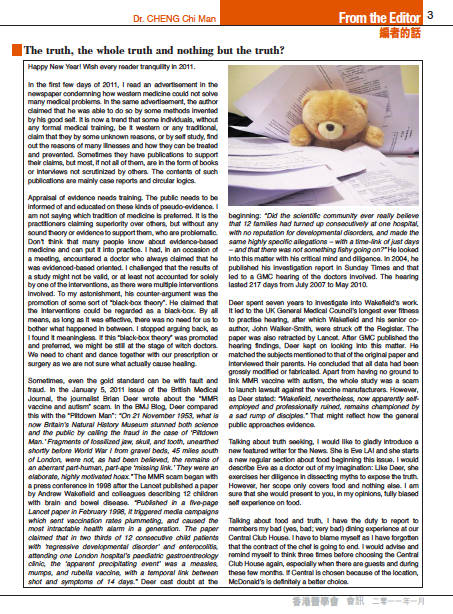
The truth, the whole truth and nothing but truth?


Happy New Year!  Wish every reader tranquility in 2011.

In the first few days of 2011, I read an advertisement in the newspaper condemning how western medicine could not solve many medical problems.  In the same advertisement, the author claimed that he was able to do so by some methods invented by his good self.  It is now a trend that some individuals, without any formal medical training, be it western or any traditional, claim that they by some unknown reasons, or by self study, find out the reasons of many illnesses and how they can be treated and prevented.  Sometimes they have publications to support their claims, but most, if not all of them, are in the form of books or interviews not scrutinized by others.  The contents of such publications are mainly case reports and circular logics.

Appraisal of evidence needs training.  The public needs to be informed of and educated on these kinds of pseudo-evidence.  I am not saying which tradition of medicine is preferred.  It is the practitioners claiming superiority over others, but without any sound theory or evidence to support them, who are problematic.  Don’t think that many people know about evidence-based medicine and can put it into practice.  I had, in an occasion of a meeting, encountered a doctor who always claimed that he was evidenced-based oriented.  I challenged that the results of a study might not be valid, or at least not accounted for solely by one of the interventions, as there were multiple interventions involved.  To my astonishment, his counter-argument was the promotion of some sort of “black-box theory”.  He claimed that the interventions could be regarded as a black-box.  By all means, as long as it was effective, there was no need for us to bother what happened in between.  I stopped arguing back, as I found it meaningless.  If this “black-box theory” was promoted and preferred, we might be still at the stage of witch doctors.  We need to chant and dance together with our prescription or surgery as we are not sure what actually cause healing.

Sometimes, even the gold standard can be with fault and fraud.  In the January 5, 2011 issue of the British Medical Journal, the journalist Brian Deer wrote about the “MMR vaccine and autism” scam.  In the BMJ Blog, Deer compared this with the “Piltdown Man”: On 21 November 1953, what is now Britain’s Natural History Museum stunned both science and the public by calling the fraud in the case of Piltdown Man.  Fragments of fossilized jaw, skull, and tooth, unearthed shortly before World War I from gravel beds, 45 miles south of London, were not, as had been believed, the remains of an aberrant part-human, part-ape missing link.  They were an elaborate, highly motivated hoax.”  The MMR scam began with a press conference in 1998 after the Lancet published a paper by Andrew Wakefield and colleagues describing 12 children with brain and bowel disease.  “Published in a five-page Lancet paper in February 1998, it triggered media campaigns which sent vaccination rates plummeting, and caused the most intractable health alarm in a generation.  The paper claimed that in two thirds of 12 consecutive child patients with regressive developmental disorder and enterocolitis, attending one London hospital’s paediatric gastroentreology clinic, the apparent precipitating event was a measles, mumps, and rubella vaccine, with a temporal link between shot and symptoms of 14 days.”  Deer cast doubt at the beginning: “Did the scientific community ever really believe that 12 families had turned up consecutively at one hospital, with no reputation for developmental disorders, and made the same highly specific allegations – with a time-link of just days – and that there was not something fishy going on?”  He looked into this matter with his critical mind and diligence.  In 2004, he published his investigation report in Sunday Times and that led to a GMC hearing of the doctors involved.  The hearing lasted 217 days from July 2007 to May 2010.

Deer spent seven years to investigate into Wakefield’s work.  It led to the UK General Medical Council’s longest ever fitness to practise hearing, after which Wakefield and his senior co-author, John Walker-Smith, were struck off the Register.  The paper was also retracted by Lancet.  After GMC published the hearing findings, Deer kept on looking into this matter.  He matched the subjects mentioned to that of the original paper and interviewed their parents.  He concluded that all data had been grossly modified or fabricated.  Apart from having no ground to link MMR vaccine with autism, the whole study was a scam to launch lawsuit against the vaccine manufacturers.  However, as Deer stated: Wakefield, nevertheless, now apparently self-employed and professionally ruined, remains championed by a sad rump of disciples.”  That might reflect how the general public approaches evidence.

Talking about truth seeking, I would like to gladly introduce a new featured writer for the News.  She is Eve LAI and she starts a new regular section about food beginning this issue.  I would describe Eve as a doctor out of my imagination: Like Deer, she exercises her diligence in dissecting myths to expose the truth.  However, her scope only covers food and nothing else.  I am sure that she would present to you, in my opinions, fully biased self experience on food.

Talking about food and truth, I have the duty to report to members my bad (yes, bad; very bad) dining experience at our Central Club House.  I have to blame myself as I have forgotten that the contract of the chef is going to end.  I would advise and remind myself to think three times before choosing the Central Club House again, especially when there are guests and during these few months.  If Central is chosen because of the location, McDonald’s is definitely a better choice.


(Source: HKMA News January 2011)